Geometric Tattoos: Where Sacred Mathematics Meets Skin Art
There’s something mesmerizing about perfect geometry etched into skin.
Geometric tattoos have surged in popularity over the past decade, appealing particularly to those who appreciate order, symbolism, and the marriage of ancient spiritual concepts with contemporary aesthetic sensibilities.
But here’s what most people don’t understand until they’re sitting in the chair: geometric tattooing is unforgiving. There’s nowhere to hide imperfection when your design is built entirely on mathematical precision. A traditional rose tattoo can have organic variations—nature itself is beautifully imperfect.
A geometric design with lines that don’t quite meet or circles that aren’t perfectly round? That’s immediately visible, permanently problematic, and impossible to explain away as artistic interpretation.
At ArtHouse Tattoo in Austin, we’ve noticed that our tech-savvy, detail-oriented Austin clientele particularly gravitates toward geometric tattoos—people who appreciate clean lines, mathematical relationships, and designs that carry deeper symbolic meaning beyond their visual impact.
Sacred Geometry and Its Tattoo Applications
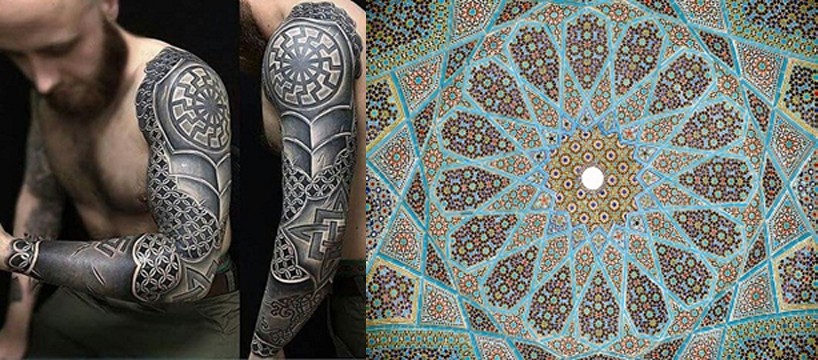
Geometric tattooing draws heavily from sacred geometry—the ancient belief that certain geometric patterns and proportions hold fundamental truths about the universe’s structure.
Many of my clients choose geometric work specifically because these patterns carry personal or spiritual significance—representing concepts like balance, interconnectedness, infinity, or the fundamental order underlying apparent chaos.
The challenge isn’t just understanding these concepts intellectually; it’s translating mathematical perfection onto skin that curves, stretches, and ages. This requires both technical expertise and honest discussion about what’s realistically achievable on human canvas!
The Technical Precision Required for Geometric Tattooing
Let’s be direct: geometric tattooing is among the most technically demanding styles in tattoo artistry!
When you’re creating a custom tattoo based on perfect circles, straight lines, and precise angles, there’s zero tolerance for shaky hands, imprecise measurements, or approximate placement. Every line must be exactly where it belongs, every circle perfectly round, every angle precisely calculated.
The technical challenges are substantial. Creating perfect circles freehand on curved skin requires exceptional hand control and years of practice.
This is why experienced artists with 20+ years across multiple styles often excel at geometric work more than artists who specialize exclusively in it. That breadth of experience teaches you how skin behaves, how different body areas distort, and how to compensate for these factors while maintaining geometric integrity. You learn the subtle adjustments needed to make mathematical perfection look perfect on biological imperfection.
During your tattoo consultation, experienced geometric artists should discuss these challenges openly. If your chosen placement creates technical difficulties, a skilled artist will explain why and suggest modifications or alternative placements.
Trust me – any artist who promises perfect geometric execution anywhere on your body without discussing anatomical challenges is either inexperienced or dishonest!
How Geometric Tattoos Age: The Honest Reality
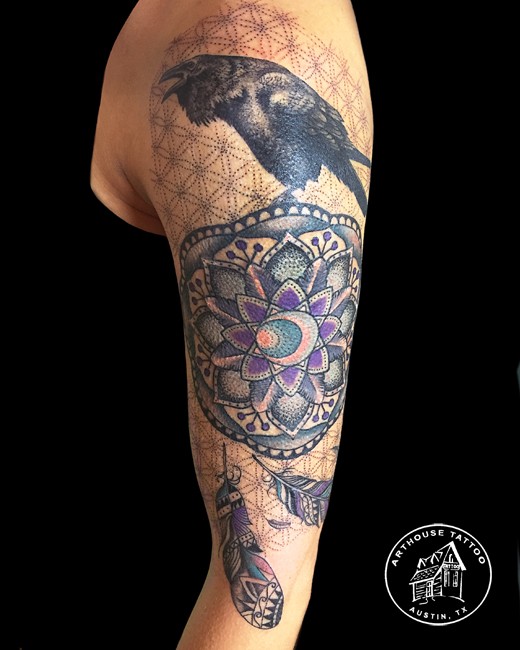
Here’s the conversation many artists avoid but you absolutely need to hear: geometric tattoos can show aging more visibly than organic, traditional designs. This isn’t a flaw in the tattooing—it’s simply how precision-based work interacts with time, skin biology, and the natural processes that affect how all tattoos age.
The primary aging factor is line spreading. Over years, tattoo lines naturally spread slightly beneath your skin as your immune system works to break down and remove the foreign pigment. In organic designs with varied line weights and natural imperfection, this spreading is barely noticeable. In geometric work where two thin parallel lines sit 2mm apart, that same spreading can make the lines blur together, destroying the precise relationship that made the pattern work.
The solution isn’t avoiding geometric tattoos; it’s designing them intelligently from the start. Incorporating slightly bolder anchor lines while keeping detail elements thinner creates structure that ages better. Using appropriate line spacing (at minimum 3-4mm between parallel lines for long-term clarity) gives room for inevitable spreading. Choosing stable body placements (upper arm, shoulder, thigh, back) rather than high-movement areas protects geometric integrity. Combining geometric elements with shading or negative space creates visual interest that doesn’t rely solely on line precision.
Placement Considerations for Geometric Success
Where you place your geometric tattoo significantly impacts both immediate execution success and long-term aging.
Some body areas are geometric-friendly, while others present challenges that even experienced artists struggle to overcome perfectly. The ideal placements for geometric work include upper arm and shoulder (relatively flat, stable skin with minimal movement), outer thigh and calf (good surface area, protected from excessive sun), upper back and shoulder blades (flat planes that work well for symmetrical designs), and forearm (popular for geometric work, though sun protection becomes crucial).
When discussing placement during consultation, experienced artists should use stencil mock-ups showing how your chosen design sits on your specific body contours. What looks perfect on flat paper may require significant adjustment to work on curved, mobile human skin. Sometimes the solution is adjusting the design to follow natural body lines.
Other times it’s choosing an alternative placement that better suits geometric precision. Occasionally it means recognizing that your dream design simply won’t work at your desired size and placement—honest input now prevents disappointment later.

Making Your Decision
Geometric tattoos represent some of the most intellectually satisfying and visually striking body art available. Their mathematical precision, symbolic depth, and contemporary aesthetic appeal to people who appreciate order, meaning, and craftsmanship in permanent art. But they’re not for everyone, and they require realistic understanding of what makes geometric work succeed or struggle.
I always recommend going into tattooing with eyes wide open. Understand that precision demands skilled execution—choose your artist carefully based on portfolio evidence and experience breadth. Recognize that geometric work ages differently than organic designs—design intelligently from the start with appropriate line weights, spacing, and placement. Commit to sun protection and long-term maintenance—geometric tattoos reward diligent care with extended clarity.
If you’re considering geometric work and want an educated, honest consultation about what’s realistically achievable for your specific design, placement, and skin, contact ArtHouse Tattoo for a free, no-commitment discussion!
We know that educated, satisfied clients matter infinitely more than quick sales—and mathematical perfection on human skin requires both exceptional technical skill and honest conversation about what’s possible!
Frequently Asked Questions
Do geometric tattoos hurt more than other styles?
Geometric tattoos hurt about the same as other styles—pain depends primarily on placement rather than design type. Bony areas, thin skin, and nerve-dense locations hurt regardless of whether you’re getting geometric patterns or traditional roses. The advantage of geometric work is that simpler designs often take less time than complex shaded pieces, potentially reducing overall pain exposure. However, complex geometric pieces with extensive line work can require longer sessions, so session duration matters more than style itself.
How much does a geometric tattoo cost compared to other styles?
Geometric tattooing typically costs the same hourly rate as other custom work at quality studios—usually $150-300 per hour depending on artist experience and location. However, geometric pieces often take longer than expected due to the precision required, which can affect total cost. Complex sacred geometry patterns with many elements may require more hours than visually similar organic designs. Size significantly impacts price, with small geometric pieces potentially starting around $200-400 and large geometric sleeves reaching several thousand dollars depending on complexity.
Can geometric tattoos be touched up if lines blur over time?
Yes, geometric tattoos can absolutely be touched up to restore line crispness, though the process requires skilled execution. During touch-ups, artists carefully reinforce faded or blurred lines without creating doubled lines or unintended thickness. Well-designed geometric work with appropriate line spacing makes touch-ups straightforward. However, designs with extremely thin lines or insufficient spacing between elements may present challenges during touch-ups, as there’s limited room to reinforce lines without creating blur. This is why designing with eventual touch-ups in mind improves long-term success.
What’s the best body placement for geometric tattoos that will age well?
The best placements for geometric longevity include relatively flat, stable areas with minimal movement and sun exposure: upper arm and shoulder, outer thigh, upper back and shoulder blades, and forearm (with diligent sun protection). These areas provide good surface area for geometric precision while experiencing less distortion from movement or environmental exposure. Avoid placing complex geometric work on high-movement joints (elbows, knees), highly curved surfaces (ribs, side torso), or areas with extreme sun exposure unless you’re committed to religious sunscreen application.
How small can geometric tattoos be while still maintaining detail?
Minimum size depends entirely on pattern complexity. Simple geometric shapes (single triangles, circles, basic patterns) can work quite small—down to 2-3 inches. However, complex sacred geometry patterns like the Flower of Life or Metatron’s Cube need sufficient size for elements to remain distinct as they age—typically minimum 4-6 inches for patterns with many components. Very intricate patterns might require 8+ inches to maintain clarity long-term. Your artist should provide specific size recommendations during consultation based on your chosen design’s complexity.
Can geometric patterns be incorporated into existing tattoos?
Geometric elements can absolutely be added to existing tattoos, though success depends on several factors. If existing work has sufficient negative space around it, geometric frameworks or borders can be added without interference. Geometric patterns can be designed to incorporate existing tattoos as central elements. However, attempting to overlay precise geometric patterns directly onto existing ink rarely works well—the new lines must sit precisely where intended, and existing tattoo elements create obstacles. During consultation, experienced artists can assess whether geometric additions will work with your existing pieces or if alternative approaches serve you better.
Are certain geometric patterns better for first-time tattoo clients?
For first-time tattoo clients interested in geometric work, simpler patterns with bold lines typically provide better experiences and outcomes. Single geometric shapes (triangles, hexagons, simple mandalas), basic sacred geometry patterns with clear structure, and geometric designs with bold line weights rather than ultra-fine detail all work well for first tattoos. These simpler approaches let you experience the tattoo process without committing to lengthy sessions, provide more forgiving aging characteristics, and give you foundation for potentially expanding into more complex geometric work later if desired. Start with quality over quantity.