
CUSTOM JAPANESE TATTOOS
There is something worth understanding about Japanese tattoos we are accustomed to: they are about as close to the authentic Japanese style as a sushi roll with cream cheese filling. Here, we said it. Shocker, we know… However, unless you’ve spent some time with the culture and the study, and the real-time apprenticeship with one of the masters of Japanese tattooing, nothing else counts. It may get close, it may look good, it may feel right to our American eye, but we’d rather call things by their real name. So that is what we are doing. Yes, you are getting the overall visual representation of the style, and we call it neo-Japanese.
And that goes for everyone working in it on this side of the world, not just us. The difference is that most shops won’t say so, because “traditional Japanese” sells and the distinction is invisible to an untrained eye. What stays, and is non-negotiable for Mike, is the meaning of each element, the overall composition, the shapes and the flow that are all as close to traditional as possible. The flow, the use of contrasts between light (skin) and dark (ink) elements, and the wrapping fluidness are what make Mike’s rendition of Japanese style work so well, and help him create Japanese tattoos that get so much love from his clients.
Tattoo Photo Gallery

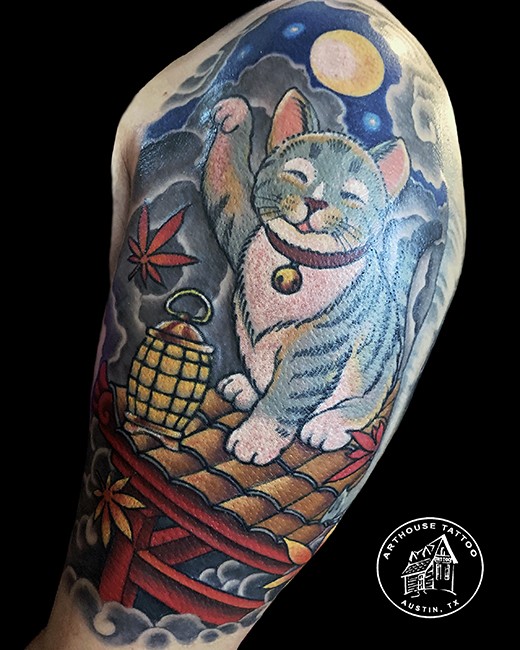


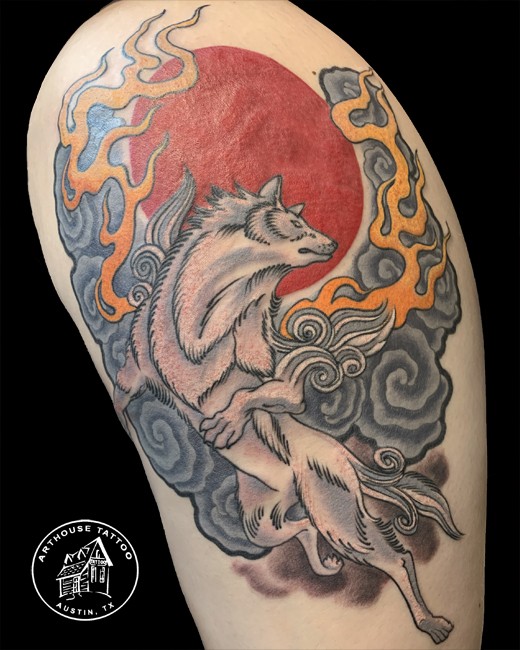

What Japanese Tattoo Symbols Mean
Most people who come in for a Japanese piece don’t actually know what they want yet. They’re drawn to the look of it. Maybe they’ll mention a koi, or a dragon, and even that is mentioned very loosely. That’s where Mike starts. He’d ask you questions like: what are you trying to say, and what qualities do you want your Japanese tattoo to carry? What do you want it to tell about you, or your life? Once he knows that, he can suggest elements and creatures that will help tell that story.
The Koi
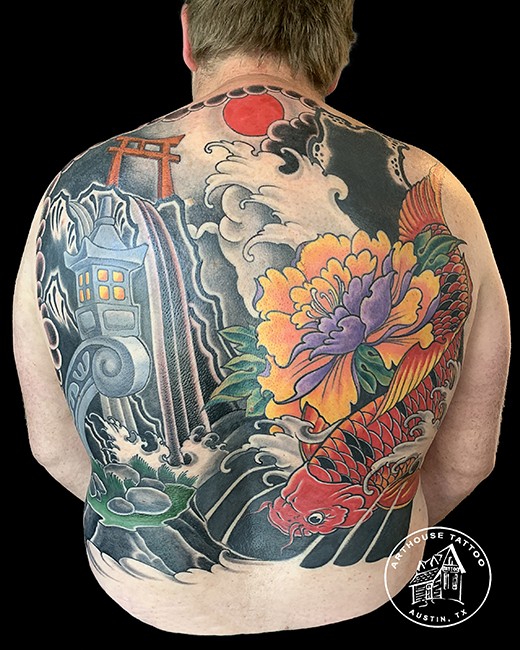
According to the legend, there was a school of golden koi swimming upstream in the Yellow River. They fought the current until they reached a waterfall, and most of them gave up and slipped back down. The ones that kept throwing themselves into the falling water caught the attention of demons, who thought it was funny and raised the waterfall higher. After a hundred years of trying over and over, one koi reached the top. The gods were so moved by its stubbornness that they turned it into a golden dragon. That’s what the symbol represents. Perseverance, and what waits on the other side of it. Color carries meaning too, and Mike will go through it with you.
The Dragon
Japanese dragons are nothing like the more familiar European ones we all know from fairytales and books. They rule the oceans and the skies, they’re water gods, and they can take human form when they want to. They stand for strength, bravery, and protection. Black for wisdom, yellow for loyalty. Six dragons come up again and again in tattooing, each with a purpose as specific as a Catholic saint. Fuku brings good fortune. Ri sees everything. The positioning matters as much as the creature. A dragon climbing upward is about progress. A dragon facing a tiger is a battle of wisdom against physical strength. There’s also an old saying that clouds follow the dragon and wind follows the tiger, and that tells you what belongs behind each of them.
The Oni and the Hannya
These two symbols get people confused constantly, so you want to know the difference before you commit to one or the other. The oni is the demon. Horned, tusked, born out of wicked human souls that went to hell and came back to punish the guilty. They carry iron clubs. Since punishing evil is their job, people wear them as protectors. The hannya is a woman. She comes from Noh theatre, where jealousy and grief turn her into a monster. The mask is carved so her face changes with the angle. Rage from one side, grief from the other. Two very different tattoos. Mike will help you to choose the one that tells your story.
The Foo Dog and the Peony
The foo dog isn’t a dog at all. It’s a lion, known as the Lion of Buddha. In Japan they’re called komainu and sit in pairs at temple gates. One mouth open, one closed, together making the a-un sound that means the beginning and the end. Because of that, they’re usually tattooed in pairs too. They guard against evil. The so popular peony symbolizes wealth, honor, courage.
The Samurai and the Cherry Blossom
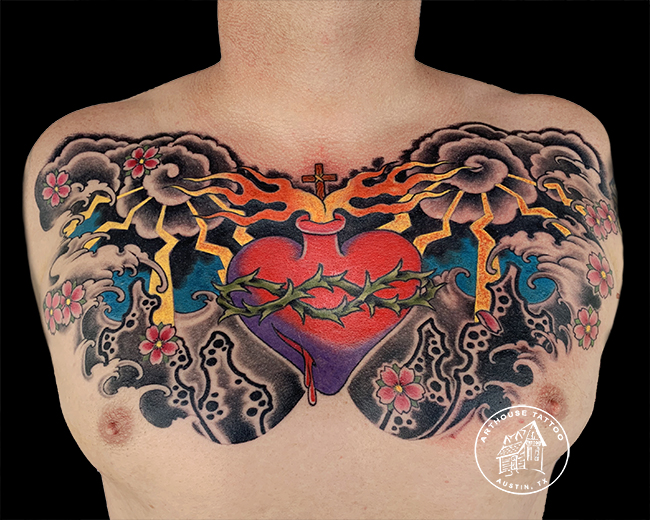
The samurai lived by an ethical and moral code known as Bushido. They represent duty, self-discipline, and loyalty. The sakura is a reminder that life is beautiful and short. The blooms disappear so fast that the Japanese hold hanami, flower viewing parties, to gather everyone in front of them before they’re gone. Interestingly, Bushido and cherry blossoms (sakura) connectet through the shared Japanese idea of impermanence, honor, and a brief and glorious existence.
The Elements of Nature
Commonly used as connecting pieces and background, the four elements of nature, combined, have their onw name, gakubori, and each of the four has its own meaning.
Water, nami. Change, force, and the ability to keep going through it. The same current the koi fights in the legend. Water belongs to the dragon, who rules it, and it’s the element the Edo firefighters covered themselves in because they worked against flame for a living. On the body, water carries the weight and anchors everything down.
Wind, kaze. Movement, speed, and the things you don’t control. Wind bars are the long tapered bands running diagonally across an arm or a leg. Wind follows the tiger the way clouds follow the dragon, so you’ll find it behind tigers, warriors, and anything falling, including cherry petals and maple leaves.
Clouds, kumo. Transition, and the line between this world and the one above it. That’s why gods and dragons come out of cloud instead of standing in front of it. Clouds also set depth, pushing one part of the design further back than another.
Rock, iwa. Permanence. Everything else in the background is moving, and rock is the thing that doesn’t. It’s what the waves break against and what the composition rests on.
Fire, hi/ka andsmoke, kemuri, appear, too. They represent life-sustaining energy, destruction and spiritual cleanse.
WHERE ARTHOUSE TATTOO IS LOCATED
ArtHouse Tattoo is located in North Austin at 15409 Ranch Rd 620 N, Austin, TX 78717, United States,
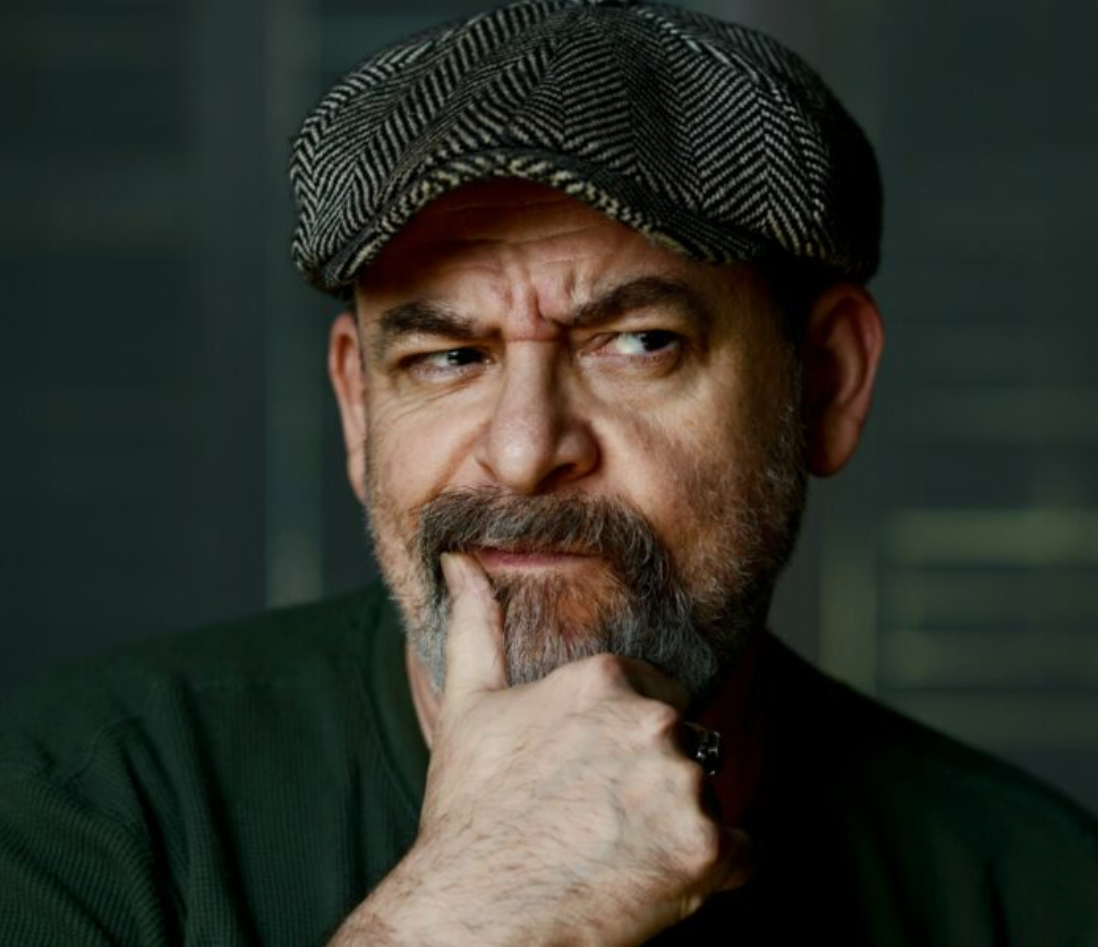
MEET MIKE METAXA, AUSTIN JAPANESE TATTOO ARTIST
Japanese is one of Mike’s all-time favorite styles to work in, and it has been for a long time.
What draws him to it is bigger than the tattoos. It’s the culture behind them. The appreciation for art as a serious thing. The attention to the shape of an object. The way aesthetics come first in Japan and everything else follows from that decision rather than the other way around.
His biggest influence in the style is Filip Leu, the French-born Swiss artist widely considered one of the finest Japanese-style tattooers alive. Leu’s dragon albums sit among the most cherished books in Mike’s library, and he still goes back to them.
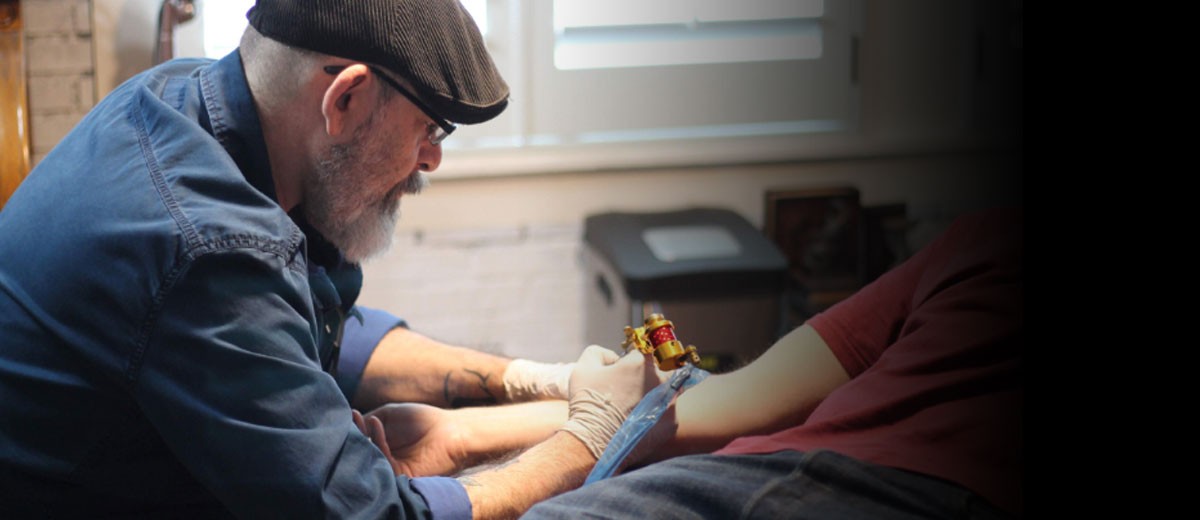
Mike has been creating custom Japanese tattoos for over 30 years. Dragons, samurai, and hannya and oni masks are the elements he’s drawn to most. Alongside the tattooing, he studies Japanese mythology and philosophy, and he uses that knowledge to gently and expertly guide his clients in choosing the elements and the story that goes into their Japanese sleeve, back, or thigh.
Other Tattoo Styles
In addition to Japanese tattoos, ArtHouse Tattoo specializes in:
Celtic & Norse Tattoos, American Traditional Tattoos, Neo-Traditional Tattoos, Illustrative Tattoos, Fusion Tattoos, Fantasy Tattoos, Cover-Up Tattoos, Custom Tattoo Design
FREQUENTLY ASKED QUESTIONS ABOUT JAPANESE TATTOOS
Do I need Japanese heritage to get a Japanese tattoo?
Not at all. Japanese tattooing has been studied, taught and worn outside Japan for a long time. Today, choosing Japanese tattoo style is a matter of personal flavor for this specific style, or a spiritual connection to the imagery, not necessarily a heritage-based one. What is worth knowing is the meaning of the elements and the imagery before deciding to put them on your skin. Mike is happy to explain and educate you on the subject to make sure it matches your vision and your story perfectly.
Will people think I’m connected to the yakuza?
Not anywhere in the US. Not in Austin. The association is real in Japan, where your visible tattoos or tattoo elements may be read the way you didn’t intend them to, and where you can still find yourself turned away from pools, gyms and hot springs if they show. Here it is being treated just as a tattoo style, no associations. Worth knowing if you travel to Japan, though.
Can Japanese be combined with other styles?
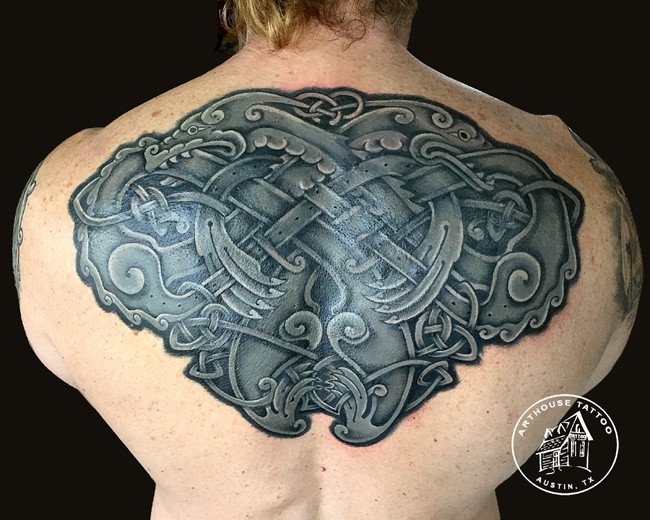
Yes, and Mike does it often, and does it well. It is a part of what’s called the fusion style. The popular combinations are Japanese with American traditional or with his illustrative work. Some of Mike’s work reflects a fusion of Japanese and Celtic, possibly one of the hardest combinations. Mike cautions that he would not suggest attempting it by someone who has no experience in doing it, or who doesn’t have a clear vision and understanding for it.
How big does it need to be?
There is no such thing as a small Japanese tattoo. The motif tells the entire story, and there’s a lot of information and detail inside it. At a small size it looks disproportional, most of the details are lost to the size, and it ends up aging terribly. That is why the placement matters. It needs space – sleeves, backs, chests, thighs.
How many sessions will a Japanese Tattoo take?
Anything from a half sleeve up is a multi session project, and the number of session is very individual. It cannot be pre-determined. Starting a Japanese tattoo project, you need to have a clear understanding that you are making a time and investment commitment. The number of session depends on the size of the project (half sleeve versus full back), the artist and how fast they work. It also depends on whether an area needs to be gone over more than once, which happens for a few reasons like poor healing from skin care that wasn’t followed, the way your own skin takes ink, which varies from person to person, and the likes. We also don’t recommend long sessions. The skin needs to rest and heal properly between them, and pushing past that damages the skin more than necessary resulting in longer (and possibly poorer) healing.
Can I start with a half sleeve and extend it later?
Yes, as long as it’s discussed and planned that way from the start. Mike designs with the full area in mind even when you’re only doing part of it now, so the composition can be easily connected and expanded when you decide to continue. A half sleeve designed as a stand alone tattoo is much harder to expand later keeping the flow going.
Can Japanese work cover an old tattoo?
Yes. In fact, it’s one of the best styles for it. The bold outlines, the dark background and the strong contrast give Mike a lot to work with, and the background is doing real work becoming part of the new design rather than just hiding what’s underneath. Whether yours can be covered depends on how dark and how big it is, which is a conversation for the consultation.